Is time graceful? Does the flow of created reality exhibit a beauty that we can rightly refer to as “grace”?
Karl Rahner makes a good case that we can consider creation as a type of grace inasmuch as it is freely given and not demanded of God. Nevertheless, his insight rests upon the firm understanding that one must not conflate supernatural grace with this as it were “natural” grace. Not only do they refer to distinct realities, but the utter gratuity of supernatural grace is categorically superior both inasmuch as such grace is given to sinners and inasmuch as it involves a profound participation in the very life of God.
John Thiel’s fascinating but problematic book Now and Forever: A Theological Aesthetics of Time exemplifies just such a conflation. When Thiel speaks of “grace,” he sometimes means supernatural grace, sometimes grace in the sense of a graceful dancer, and sometimes both at the same time in a confusing and entangled manner.
To be clear, I often defend the right of a theologian to utilize the polyvalence of words in such a way that the ambivalence of a term might yield a plurality of meanings. Yet Thiel goes too far. By continually overlapping “grace” and “grace”—the divine gift and the comely movements of a dancer—Thiel risks collapsing the former into the latter. Is God’s grace nothing more than the apparent orderliness and beauty of temporal existence? Does such intrinsic beauty of itself overcome all ills by its soothing magnificence?
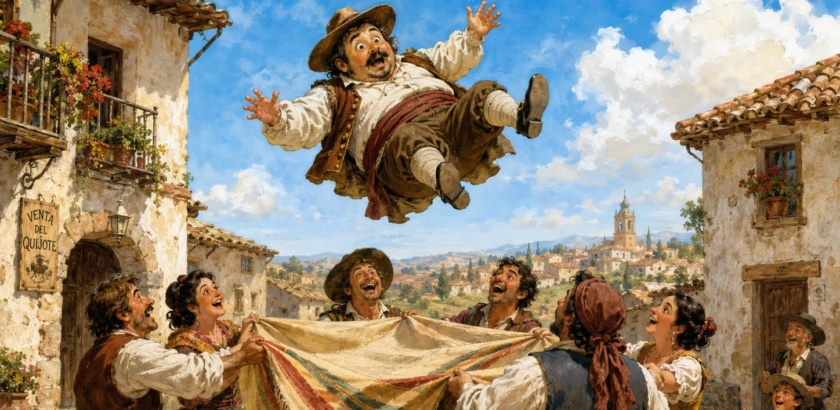
Even a simple goatherd knows better, for when Don Quixote compliments one, this cabrero redirects the knight-errant’s words back toward the grace that actually saves.
“That is true,” said Don Quixote, “and please continue; the story is very good, and you, my good Pedro, tell it with a good deal of grace.
“May God’s grace be with me, that’s the one that matters.”1Book I, ch. 12; Grossman, 84.
Thiel builds this ambiguity between supernatural grace and temporal gracefulness quite intentionally. Seeking to ground an eschatology of universal salvation in a theological aesthetics of temporality, Thiel characterizes temporality as “graceful” in order to claim that time’s eschatological extension would carry the power to overcome the history of pain and evil. If a person does not repent in this life, Thiel reasons, then the indefinite continuance of time in the world hereafter will inevitably result in such a conversion. Sooner or later, each of us will give in to God’s forgiving embrace. Thus, eventually—no matter how many aeons it may take—each and every person will be saved.
In discussing the book with my eschatology students, a key question popped into my head: Is this “good news”? This question is difficult to answer with a swift affirmative. If we claim that universal salvation lies couched within the meaning of the Bible, then it must be Gospel, “good news” for humankind. Yet in what key or register can we proclaim that the history of evil loses all significance without thereby authorizing, excusing, or otherwise whitewashing this history in such a way that would serve to justify its existence? In short, can anyone with full honesty, compassion, and gravity say, “Well, the Holocaust wasn’t that bad anyway.”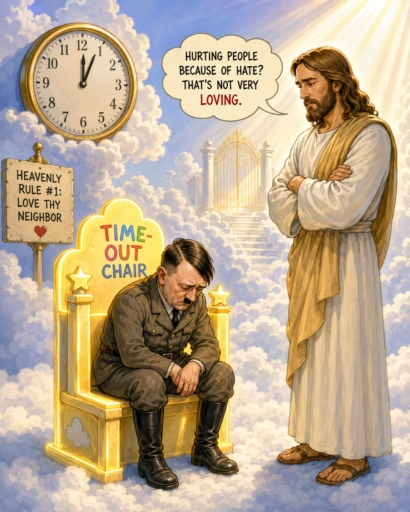
This problem reminds me of one of Sancho’s most accidentally profound statements to Don Quixote. At one point, Quixote remarks:
“Even so, I want you to know, brother Sancho, … that there is no memory that time does not erase, no pain not ended by death.”2Book I, ch. 15; Grossman, 107.
Fair enough, right? Time erases all ills. —Or does it? In reality, time does not erase but merely dwarf the past. An individual wrong loses its significance up against a far broader history. It is a matter of gain vs. signal, like how one off-key voice in a choir becomes difficult to hear amidst a crowd of good singers. Sancho seems to notice this when he responds, quite ironically:
“Well, what misfortune can be greater … than waiting for time to end it and death to erase it?”
Certainly time appears to be our friend in the fight against evil, but in the long run all it can do is soothe the pain like a makeshift poultice. It cannot truly erase the wound any more than a bandage can undo a scar.
In my own theology, I have tried to compass this problem by speaking of the unending sorrow that becomes eschatologically overwhelmed by infinite joy. Yet Thiel’s approach highlights the potential pitfalls that lie even in my own approach if it is not carefully expressed so as to encapsulate the subtle yet non-collapsible dichotomy of this dialectical situation. To say that eschatological joy can overcome the tragedy of sin is not to say that sin simply did not happen, or does not matter, or ought to be forgotten wholesale. No one in right charity can rob the victims of suffering of their right to cry out unto God.
What’s key is that the victory of joy over tragedy cannot be a mere quantitative overcoming. Joy does not win out simply because there happens to be more of it than sorrow. Rather, only if joy is qualitatively greater, only if joy is infinitely more infinite can it overcome the historicity of pain and evil without pretending to erase it. In this sense it remains true that “To forgive is not to forget,” and yet authentic forgiveness remains the power to move on ahead without being bound by the oppressive dominance of the past.
In other words, supernatural grace does not merely characterize the flow of present time into the future. Rather, it is a gracefulness that constructs an authentic future by delivering upon the hope to carry on.
- 1Book I, ch. 12; Grossman, 84.
- 2Book I, ch. 15; Grossman, 107.