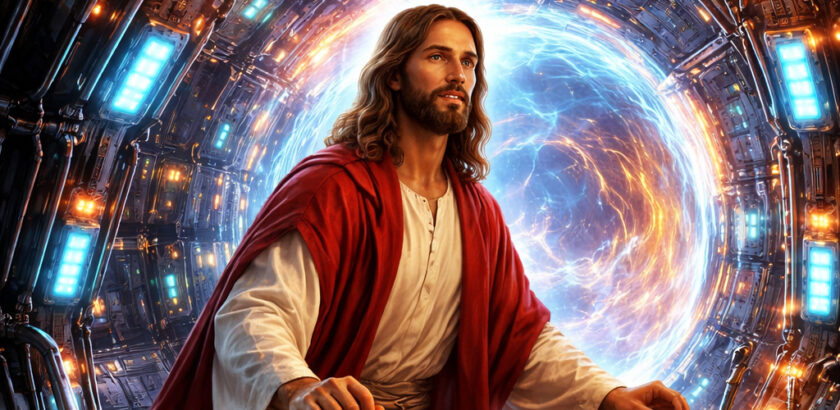

I have to admit that I would not be a very polite time traveler. I’d be the chronological equivalent of the rowdy American who goes to France and demands access to their fries. I have a very good reason for this though. Most time travel fictions include some claim that one must respect the space-time continuum by doing and affecting as little as possible. In my view, however, if time is so fragile that it can’t handle a little meddling, then perhaps it deserves to implode in on itself. Hence I would make it my temporal duty to fix what seems broke, try out alternate futures, and perhaps win a few lotteries.
On that note, I came across some peculiar nonsense in my research on Anselm’s satisfaction theory. In a 2017 essay, Samuel Lebens and Tyron Goldschmidt argue that, based on supposed biblical and Hassidic evidence, Christ’s atonement and divine forgiveness must mean that God will actually (eschatologically?) emend history so as to make it that our sins never happened in the first place.1 In other words, it’s not just that God forgives, nor even that God forgets, but that God actually modifies history itself to remove any stain and make everything the way it ought to have been in the first place. (It’s the divine equivalent of Ctrl+Z.)
Don’t get me started on all the strange technical hurtles this seems to entail. Sure, God can do whatever God wants, but what if erasing the entire history of human warfare suddenly multiplies the human population a hundredfold while simultaneously nullifying the existence of anyone whose ancestry came about by rape? Could God’s hatred of sin go so far as to erase the existence of someone God loves?
Of all the many, many critiques of such a claim, however, I think the most important theological argument concerns the nature of historicity and human freedom. Lebens believes that his position somehow strengthens free-will theodicy, i.e., the argument that human freedom alone (and not God) is responsible for human sin. Yet the power and seriousness of human freedom stems precisely from what I term its historicity. In this frame, historicity refers not simply to the reality of past events but rather to the complex manner in which such events exercise an irrevocable influence on everything that follows.
Augustine’s formulation of original sin is remarkably profound for this very reason: far from eliminating human freedom as Pelagius feared, it actually awards such freedom the highest significance. God created humans with such a powerful faculty of free-will that by this freedom we are capable not only of catastrophically impacting the flow of history but even of damning ourselves for all eternity. Human freedom is so consequential that what our first parents did mattered in the utmost: it placed the entire history of the human race under the dominion of sin. And yet, these negative possibilities are only the lesser flipside of the more radical positive possibility of building history for the good and binding ourselves to Christ for eternal salvation.
For God to simply nullify history—to disregard our free decisions and replace them with something else—would do violence to the very concept of the human person as a free individual responsible before God. No, God will not whitewash history. Just as we must remember the sins of the past (taking in both the good and the bad among our forebears) so as to renounce and counteract them, so also must we accept history as a whole as the material basis for that transfigured reality that the book of Revelation terms the new heaven and the new earth (21:1). Certainly this means that history will never cease to be the object of an unending sorrow on the part of the just. Yet as I have said elsewhere, the infinite sorrow cannot be erased but only overcome by a qualitatively superior eternal joy.
- Samuel Lebens and Tyron Goldschmidt, “The Promise of a New Past,” Philosopher’s Imprint 17, no. 18 (2017); Samuel Lebens, “Time for Some Robust Atonement,” Faith and Philosophy 40, no. 1 (2023): 1–23. ↩︎